Still in keeping with the “disasters” theme…
The Last Day of Pompeii by Karl Bryullov
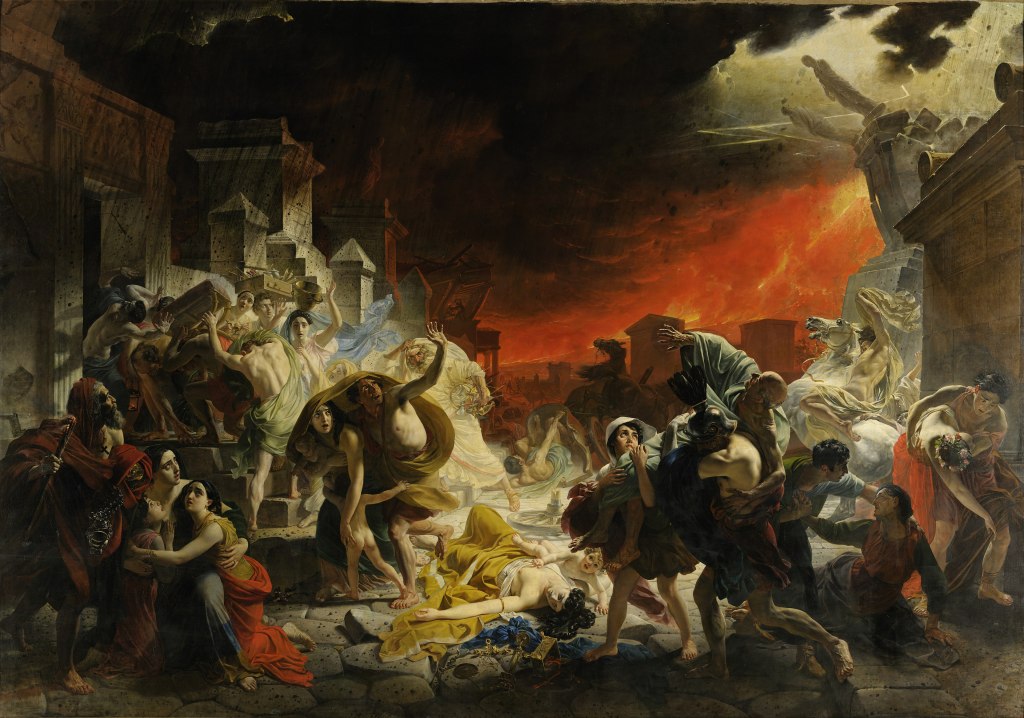
This piece inspired Edward Bulwer-Lytton’s novel The Last Days of Pompeii, which itself sparked several film adaptations starting with a 1908 Italian silent film and running through Hollywood productions in 1913, 1935, and 1959.
The canvas is nearly five meters wide and took three years to complete. Before starting it, Bryullov walked the actual streets of Pompeii and used Pliny the Younger’s eyewitness account of the eruption as source material. He also quietly inserted himself into the scene. He’s the figure near the center with a paintbox balanced on his head.
When it finally arrived in Russia, people read something darker into it. Gogol and others saw it as a warning about St. Petersburg: same imperial grandeur, same inevitable collapse. The dissident Alexander Herzen saw it as an allegory for the tyranny of the Russian state.
Pushkin wrote a poem about it too.
Image Source: Wikimedia Commons
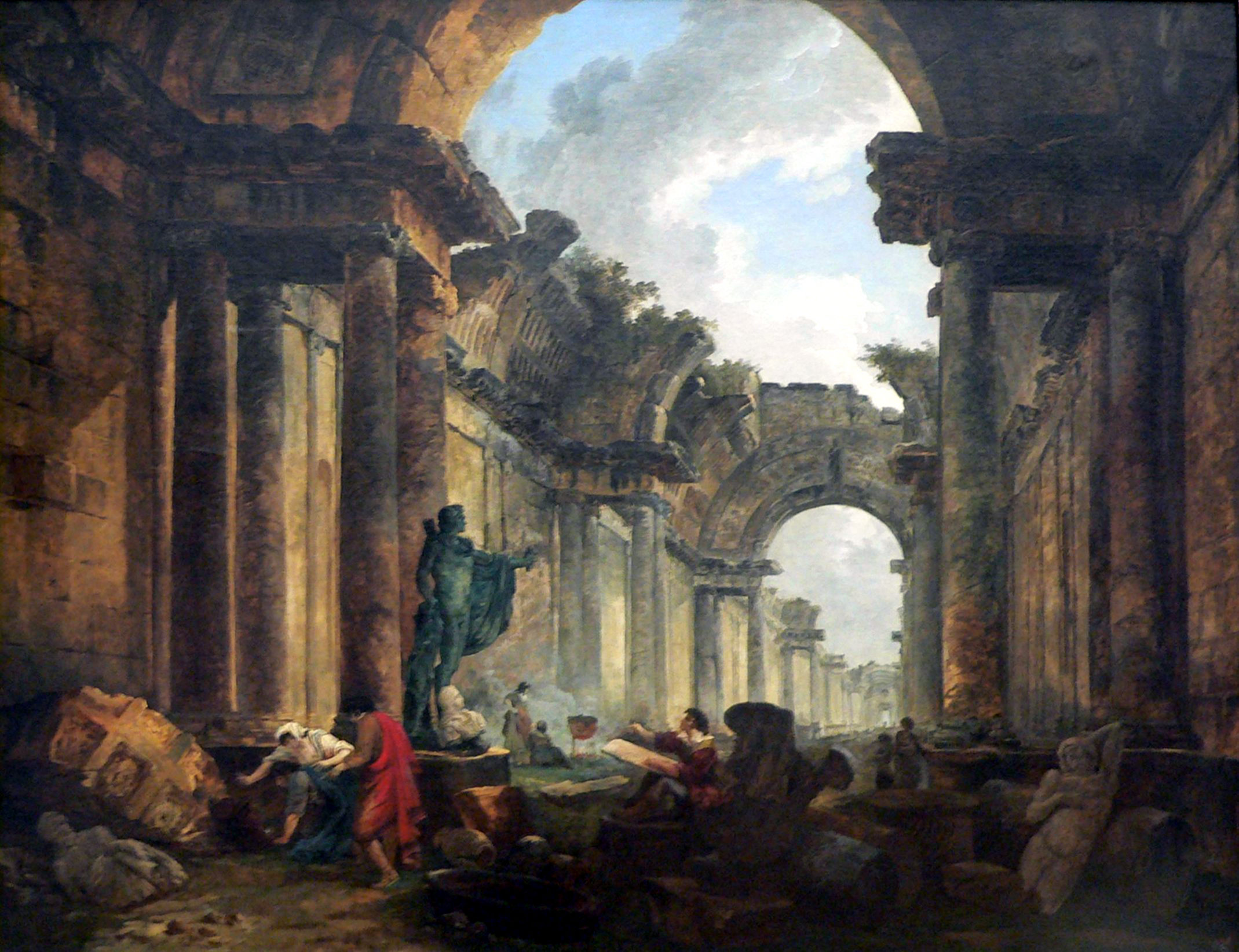
Imaginary View of the Grand Gallery of the Louvre in Ruins by Hubert Robert
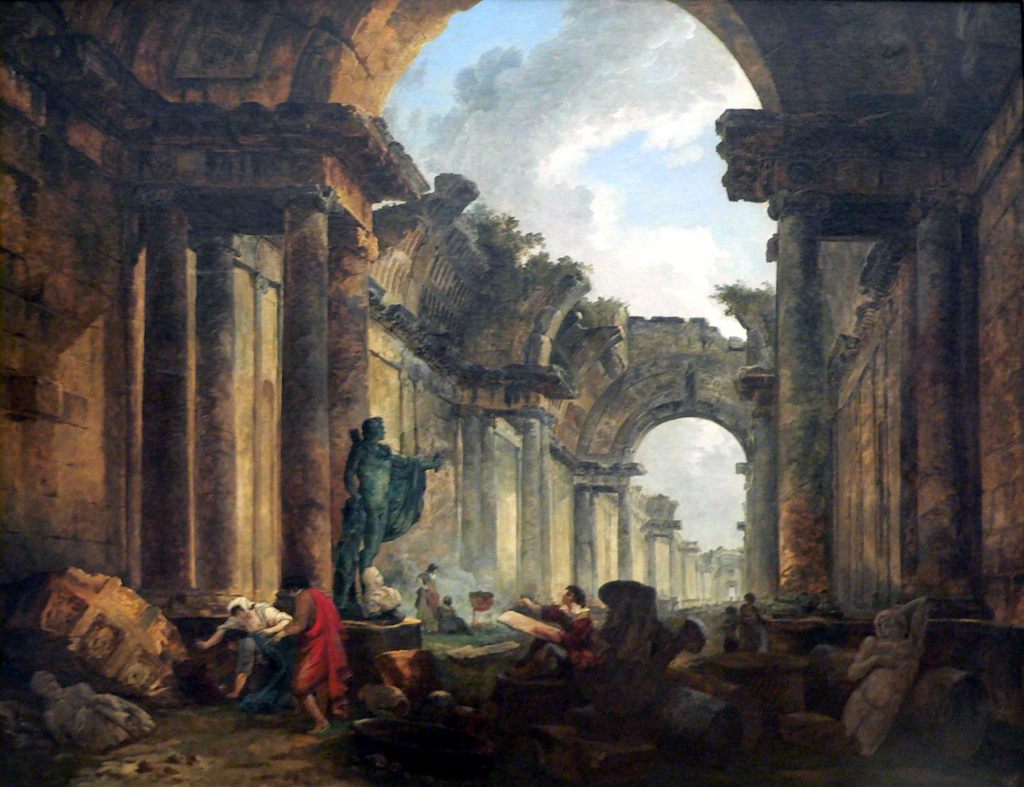
Robert painted this while sitting in his office at the Louvre, where he had just been appointed keeper of the museum’s collection. He was imagining the building he worked in collapsing around him.
The painting exists as a pair. In the same year, Robert also painted the gallery restored and thriving. He submitted both at the same time: one showing the museum as it could be, the other showing it as dust.
Robert earned the nickname “Robert des Ruines” for his obsession with decay. He spent eleven years in Rome sketching ancient ruins, filling albums that supplied him with source material for the rest of his career.
He came close to not being around to paint any of it. Arrested during the Revolution in 1793, he survived only because another prisoner with a similar name was guillotined in his place.
Image Source: Wikimedia Commons
Desolation (The Course of Empire) by Thomas Cole
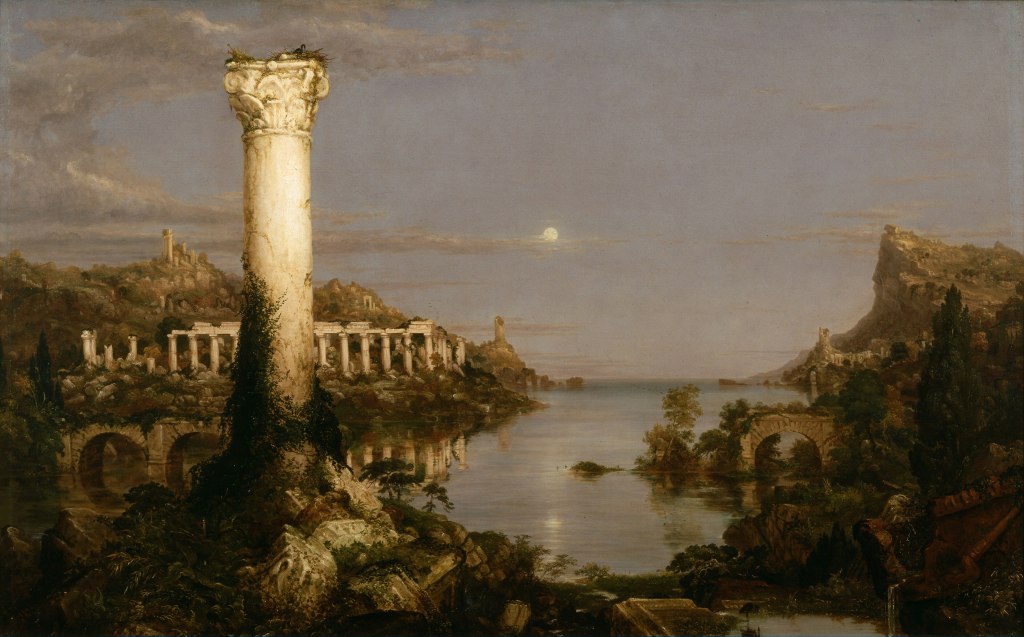
This is the fifth and final painting in Cole’s “Course of Empire” series, which traces the rise and fall of a civilization across five canvases. By the time you reach Desolation, there are no people left. Just columns and arches being slowly swallowed by vegetation, a heron nesting on the last standing pillar, and a moon rising over all of it.
The image of a recognizable human structure being reclaimed by nature became a template. The shot of Charlton Heston discovering the Statue of Liberty buried in sand at the end of Planet of the Apes (1968) is this painting’s direct descendant.
Cole painted the series for New York merchant Luman Reed, who commissioned it for a private gallery in his Manhattan mansion. Reed died before it was finished and never saw the last two paintings.
American critics read the whole series as a warning about their own country. Cole reportedly disliked Andrew Jackson’s populism (dasurv), and many saw the final panel as a forecast of what democracies eventually become.
Image: Wikimedia Commons
Abbey in the Oak Wood by Caspar David Friedrich
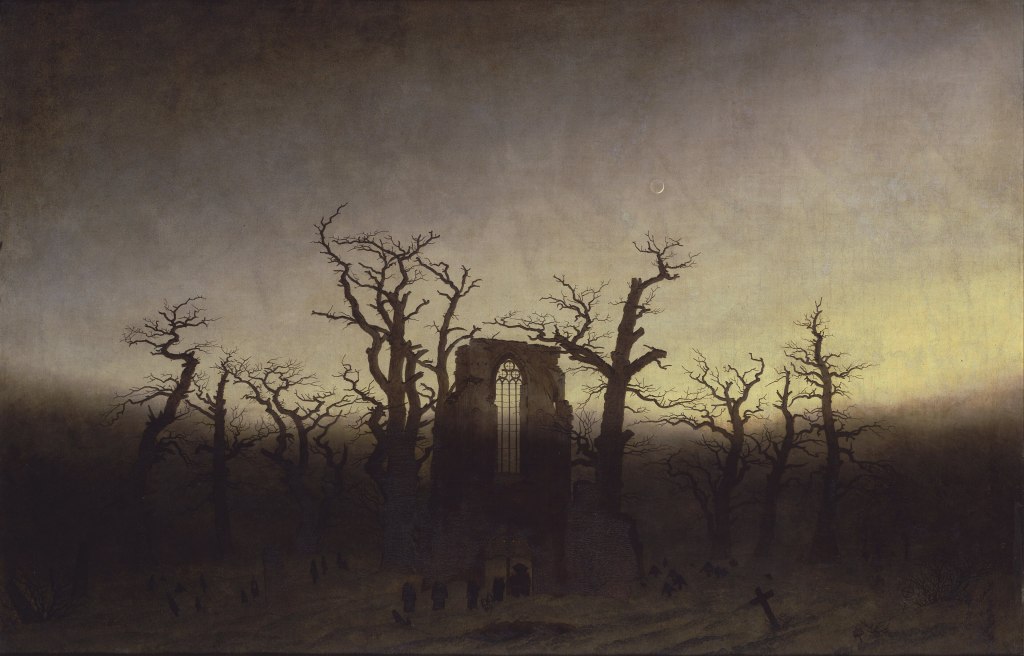
Friedrich painted this during the Napoleonic Wars, and it shows: a ruined Gothic abbey surrounded by leafless oaks, a small procession of monks carrying a coffin through the doorway, and fog everywhere. Nobody was painting gloom quite like this in 1810.
The ruins are real. Friedrich based them on the Eldena Abbey near his hometown of Greifswald, which he sketched repeatedly throughout his life. The abbey had been dissolved in 1199 and was a genuine wreck by the time Friedrich was drawing it.
King Friedrich Wilhelm III of Prussia saw the painting at the Berlin Academy in 1810 and bought it on the spot. It has been in Berlin ever since.
In German Romantic painting, oak trees represented the Germanic spirit and the Germanic past. Stripped bare in winter, they looked like ruins themselves.
Image: Wikimedia Commons
 Kuma The Curator



Leave a comment