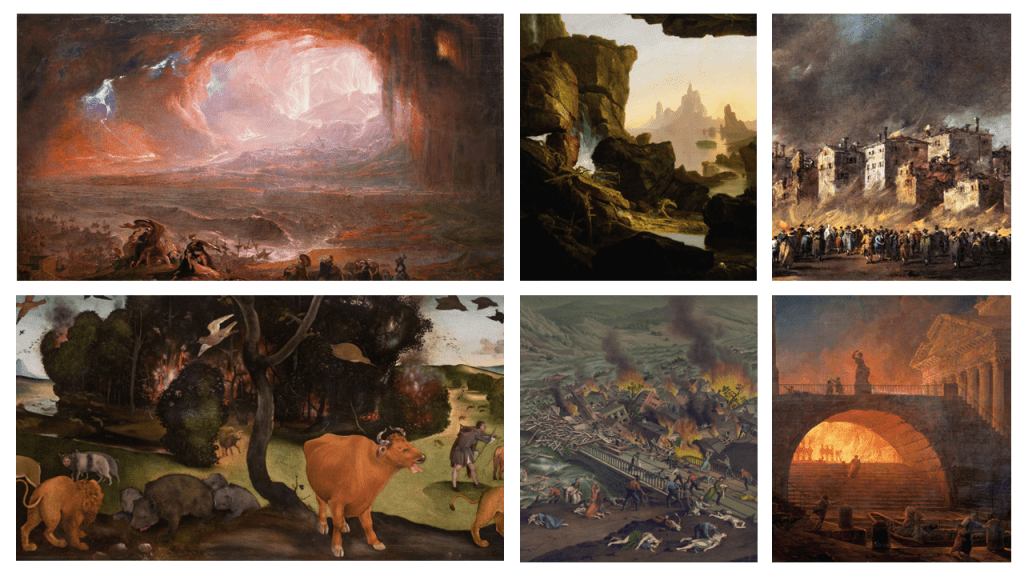
It’s been a while since I last made an entry, but I felt compelled to explore disasters as a theme. Events like alien invasion, earthquakes and tsunamis are recurring nightmares for me. Maybe it’s my brain’s way of trying to wake me up during episodes of sleep apnea. During these apnea events, the body experiences significant stress from not receiving enough oxygen. This stress can manifest in vivid and unpleasant dreams.
Unfortunately, I couldn’t find any works in the public domain that depict alien invasions so I included a mysterious phenomenon in 1561 that was documented in a broadsheet.
The Destruction of Pompei and Herculaneum by John Martin

When it was first exhibited in 1822, The Destruction of Pompeii and Herculaneum created a massive public sensation, attracting large crowds—reportedly 50,000 visitors within just a few months. This commercial success was unusual for artists of that era and highlighted the significant popular appeal of apocalyptic and historical themes.
Once thought lost after being severely damaged by the 1928 Thames flood, it was rediscovered by a research assistant working at the Tate Gallery and then painstakingly restored.
John Martin was called “Mad Martin” by some of his contemporaries. I am not sure why.
Image Source: Wikimedia Commons
Fire in the oil warehouses at San Marcuola by Francesco Guardi

This painting, created just before the fall of the Venetian Republic in 1797, can be interpreted as a subtle symbolic representation of the city’s declining fortunes—an unintentional yet powerful metaphor for its imminent end.
Image Source: Wikimedia Commons
The Subsiding of the Waters of the Deluge by Thomas Cole
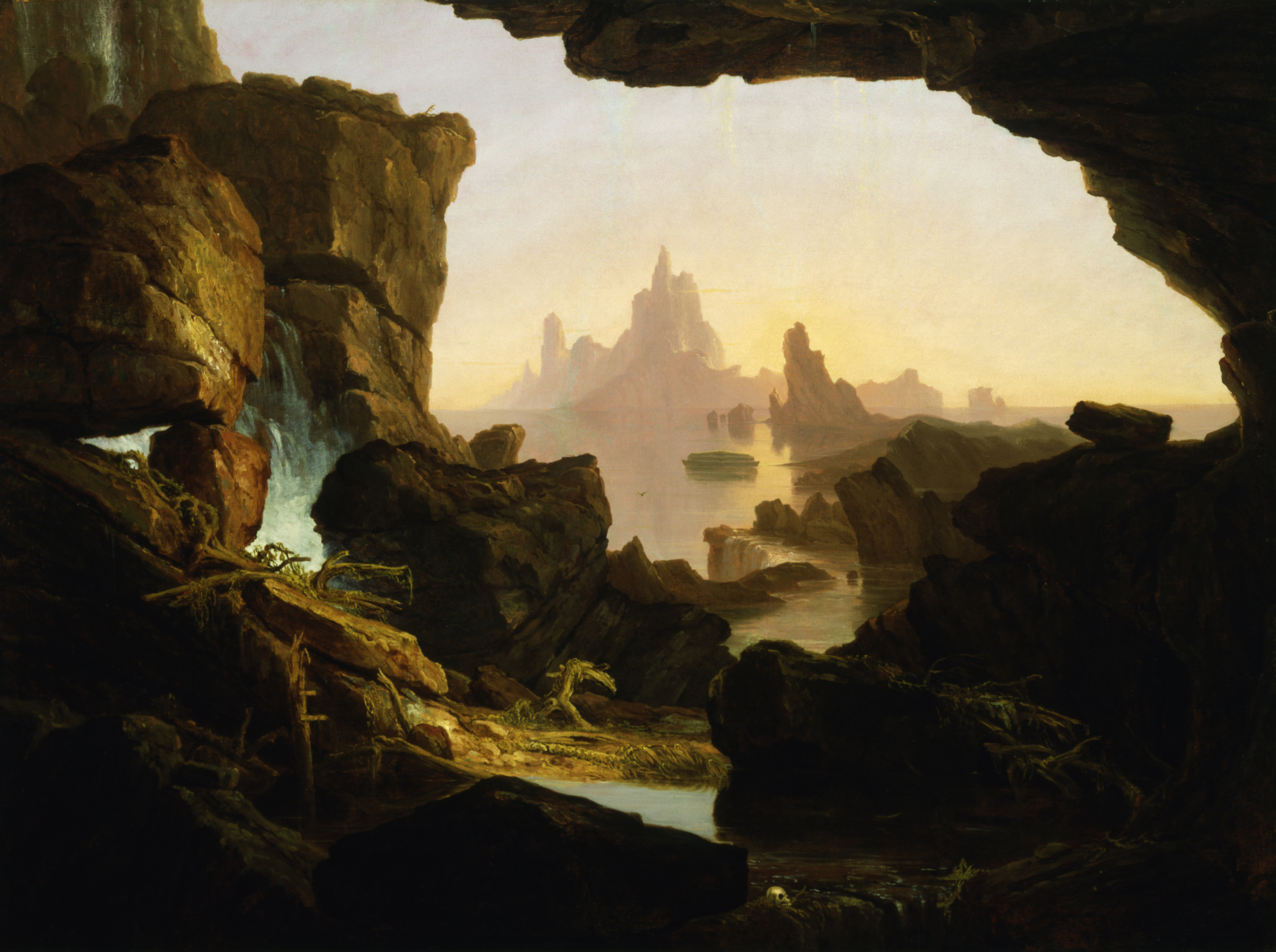
Thomas Cole’s allegorical portrayal of America as a “”New Eden”” in The Subsiding of the Waters of the Deluge was intentional. He envisioned America as a new start for civilization, with the American Revolution akin to the biblical Great Flood, cleansing the land of European despotism. The painting suggests a peaceful future for the young republic, a land washed clean of human folly, ready to usher in a new and enlightened era.
The idea of America as a “”New Eden,”” “”cleansed”” for a new civilization, is sickening when one considers the reality of its founding, a history violently at odds with Cole’s artistic vision.
Image Source: Wikimedia Commons
The Great Conemaugh-Valley Disaster-Flood by Kurz & Allison

This piece describes the devastating wall of water—towering waves reaching up to 40 feet high—that inundated Johnstown after the collapse of the South Fork Dam. The flood carried with it a significant amount of debris, which got trapped against the Pennsylvania Railroad Stone Bridge. As the wreckage piled up, it caught fire, turning the bridge into a raging inferno that claimed hundreds of additional lives amid the destruction caused by the flood.
Image Source: Wikimedia Commons
The Fire of Rome, 18 July 64 AD by Hubert Robert
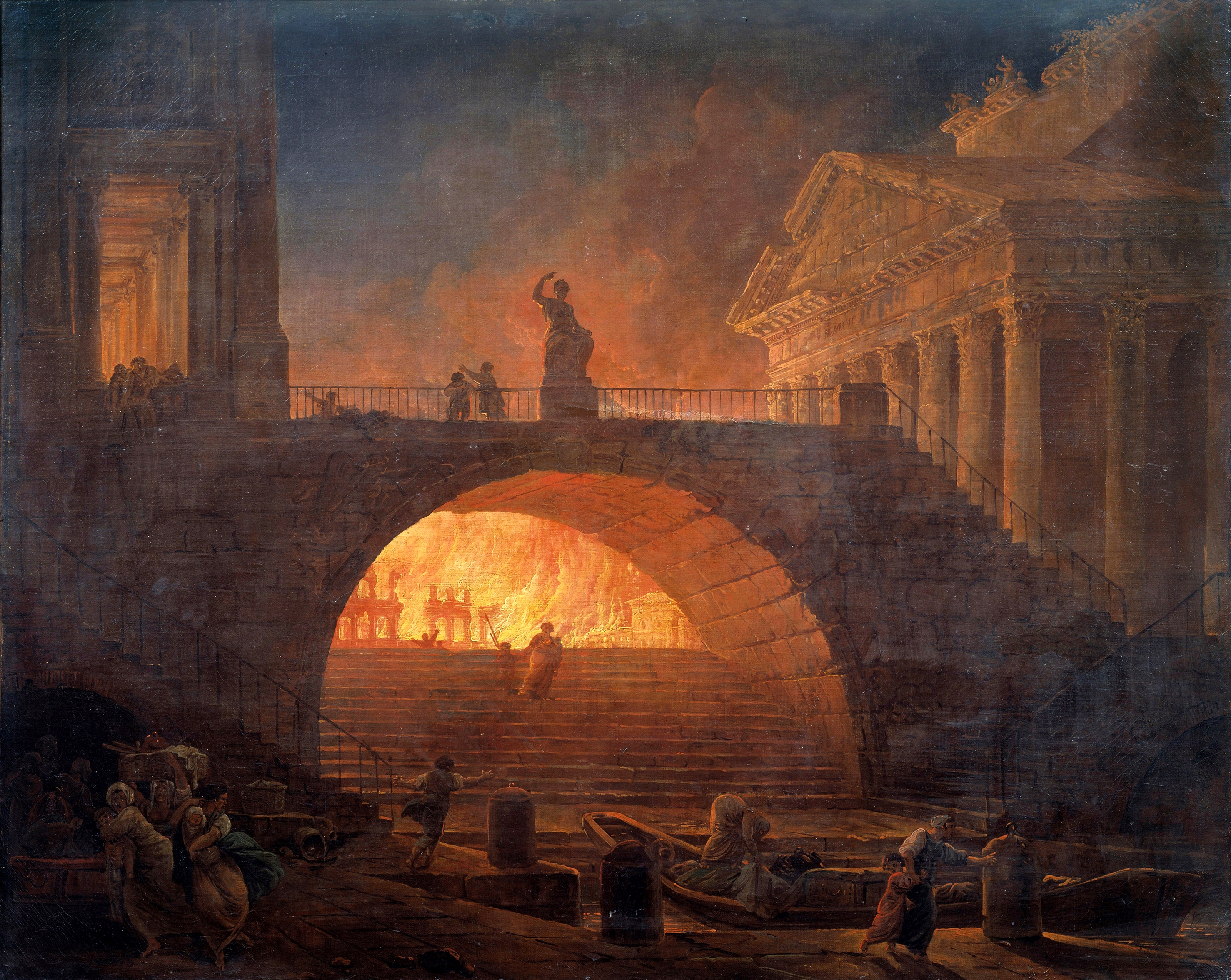
Hubert Robert’s painting, The Fire of Rome, 18 July 64 AD, depicts one of the most devastating urban fires in ancient history. It burned for days and destroyed large portions of the city. This event is controversially linked with Emperor Nero, who was widely suspected of having started the fire. In the aftermath, he blamed the emerging Christian community, leading to severe persecutions against them.
Image Source: Wikimedia Commons
The Forest Fire by Piero di Cosimo

Unlike many disaster paintings from the era, which often depicted biblical events like the Flood or the Last Judgment, The Forest Fire stands out because it focuses on a non-religious theme. The lack of divine intervention or a prominent human hero makes the fire seem like a purely natural and overwhelming force. This approach contrasts sharply with numerous Renaissance works that center around humans or gods as the focal point of the universe.
Image Source: Wikimedia Commons
The 1561 Celestial Phenomenon over Nuremberg by Hanns Glaser
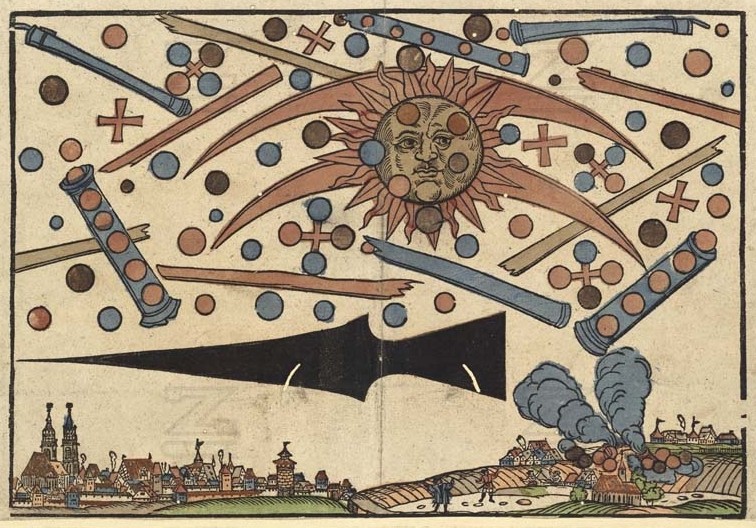
Witnesses reported seeing numerous spherical, cylindrical, and cruciform objects seemingly engaged in a dramatic sky battle. This broadsheet article illustration stands as one of the most famous and debated historical accounts of unusual atmospheric phenomena, with some interpreting it as an early UFO sighting or even an alien conflict.
The translated text of the article is absolutely fascinating!
Image Source: Wikimedia Commons
 Kuma The Curator

_Fire_in_the_oil_warehouses_at_San_Marcuola_by_Francesco_Guardi_-_Gallerie_Accademia.jpg)


Leave a comment