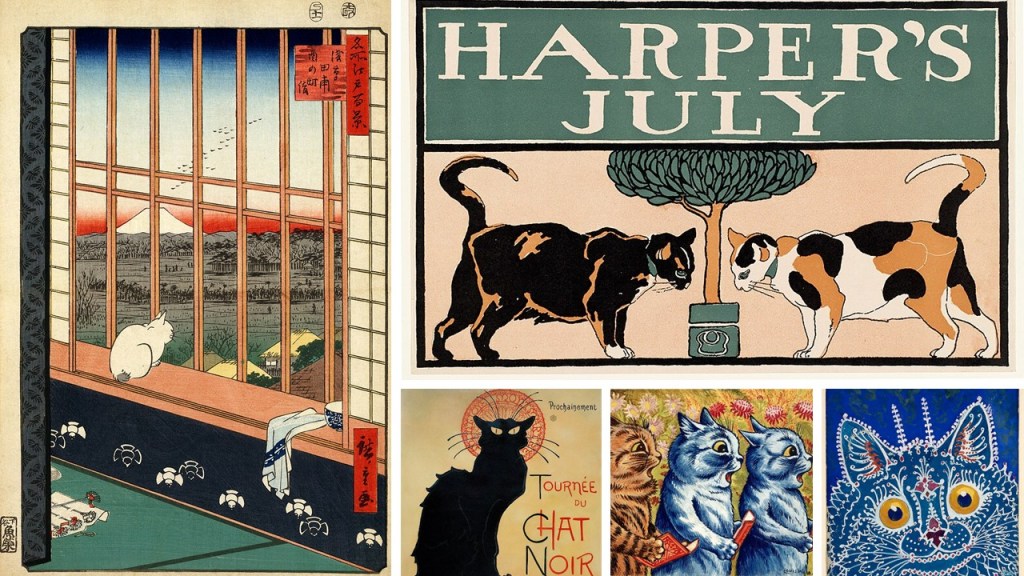
As someone who loves cats but doesn’t have one, I’ve put together a mini-collection of five artworks featuring them. Naturally, two of the pieces are by Louis Wain, the master of cat art, and you’ll see why. I also selected a couple of works that share some interesting stylistic elements.
A Cat in Gothic Style by Louis Wain

As a devoted cat person, Louis Wain made thousands of cat illustrations. This particular “Gothic” cat, with its intricate lines, offers a peek into a unique thematic exploration within his broader abstract phase. It’s a significant piece because it marks a time when Wain’s art started to get more complex and, at times, a bit unsettling—perhaps a reflection of his declining mental health. See Kaleidoscope Cats I–VIII (1920s/30s).
Image Source: Wikimedia Commons
Three cats singing by Louis Wain

Louis Wain drew so many cats for an unfortunate, personal reason. His wife Emily got sick with breast cancer not long after they got married. To cheer her up, he’d sketch their cat, Peter, often making him act all human-like and funny. Those drawings made Emily happy and encouraged him to pursue art full-time. Even after she passed away, Peter stuck around as his main inspiration, pretty much kicking off Wain’s whole career drawing cats.
Image Source: Wikimedia Commons
Asakusa Rice Fields and Torinomachi Festival by
Utagawa Hiroshige

Part of Utagawa Hiroshige’s “”One Hundred Famous Views of Edo”” series, this work captures the energy of the Torinomachi Festival as people stream across the rice fields, all while a rather curious cat observes the scene from a window. According to art historians (Henry D. Smith II etc.), there’s a subtle suggestion that the interior setting is a courtesan’s quarters in the Yoshiwara district. Hints include a scattered hairpin and a towel. What makes Hiroshige a genius here is how he pulls off this trick: he takes a private, up-close look from inside and somehow blends it perfectly with a huge, sweeping landscape. He’s telling multiple stories all at once, right there in one woodblock print (ukiyo-e).
Image Source: Wikimedia Commons
Harper’s July by Edward Penfield

Speaking of ukiyo-e, Edward Penfield was heavily influenced by Japanese woodblock prints, which were gaining popularity in the West at the time. You can see this influence in his use of flat areas of color, bold outlines, and simplified forms, all of which are evident on the July cover of Harper’s magazine. Penfield was a pivotal figure in American graphic design, revolutionizing the art of posters and magazine covers, especially through his numerous works for Harper’s Magazine.
Image Source: Wikimedia Commons
Tournée du Chat Noir by Théophile Alexandre Steinlen

Théophile Alexandre Steinlen’s “Tournée du Chat Noir” is a lithograph created in 1896 to promote the touring shows of the famous Montmartre cabaret, Le Chat Noir aka the Today X Future of 19th century Paris. Steinlen was a committed socialist and often used his art to highlight social issues and critique injustices.
Image Source: Wikimedia Commons
 Kuma The Curator


Leave a comment